
A Recognisable Fracture
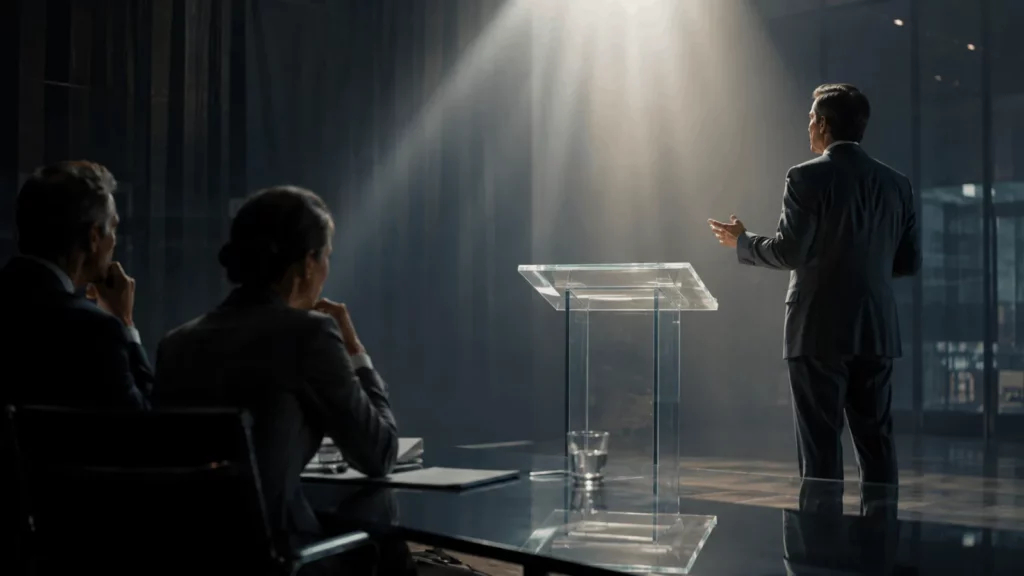
The leadership speech lands well. The language is thoughtful. The tone is steady. People nod, repeat the key phrases and perhaps even feel a temporary sense of reassurance.
Then the real test begins.
A week later, a decision is made that seems to contradict the message. A cost pressure is handled in a way that exposes different priorities. A senior leader behaves as if the speech was for the room, not for the organisation. Nothing dramatic happens at first. No public crisis. No obvious rupture. Just a small internal recalibration.
People start to listen differently.
This is where credibility is won or weakened. Not in the town hall. Not in the carefully prepared statement. Not in the values slide. Credibility is earned in the space between what leaders say and what people experience after the words have settled.
Why This Moment Matters
Organisations have become highly skilled at messaging. They can frame change, explain strategy, soften difficult announcements and speak fluently about purpose, belonging and responsibility.
The harder work is alignment.
Employees and stakeholders no longer judge leadership communication as a standalone act. They read it against behaviour, incentives, decisions and consequences. This is why credibility cannot be managed through language alone. Language may open the door, but decisions decide whether people walk through it.
The 2026 Edelman Trust Barometer points to a world where trust is narrowing into smaller, more familiar circles. Edelman describes employers as especially important trust brokers in this environment, because work remains one of the places where people encounter leadership, difference and shared consequence in practical terms.
That raises the standard for leaders. People are not asking for perfect certainty. They are asking whether the message they heard will survive contact with commercial pressure, political tension, restructuring, AI disruption, investor demands and difficult trade-offs.
The Evidence on the Ground
The trust gap is not theoretical. PwC’s 2024 Trust Survey found that executives continue to overestimate how much they are trusted by both customers and employees. It also found that employees were more likely to trust their company when their direct supervisor involved them in important decisions.
That finding matters because credibility is not only shaped by senior intent. It is shaped by proximity. People judge the organisation through the manager who interprets the message, the decision that affects their team and the moment when they are either included or bypassed.
At the same time, Gallup’s State of the Global Workplace 2026 reports that global employee engagement declined for a second consecutive year in 2025, with manager engagement also under pressure. When managers are strained, unclear or unsupported, the gap between leadership messaging and employee experience widens quickly.
The research points to a simple organisational truth: credibility is not a communications outcome. It is a system outcome.
What Leaders Actually Face
Most leaders do not set out to be inconsistent. The problem is usually more complex and more ordinary.
A leader says people matter, then approves a process that treats them as an afterthought. A company says it values transparency, then withholds information until rumours do the explaining. A board says integrity matters, then rewards results achieved through behaviour everyone quietly knows is corrosive. A strategy message promises focus, then the business adds more priorities without removing anything.
The damage is cumulative.
People do not need every decision to go their way. They do need to understand the principles behind decisions. They need to see that words have operational consequences. They need to believe that when leaders speak about values, the organisation is prepared to pay some price for them.
This is why the credibility gap often opens after the speech, not during it. The speech creates an expectation. The decision either honours it or exposes it.
The Path Through Integrity
The Balanced Movement perspective is that credibility sits at the intersection of behaviour, language and decisions.
Language gives meaning. Behaviour gives evidence. Decisions give proof.
A credible leader does not rely on charisma to carry contradiction. They reduce the contradiction. They do not assume that a well-crafted message will compensate for misaligned incentives. They ask whether the organisation is prepared to make the message visible in how it allocates resources, manages pressure, promotes people and handles dissent.
This is where moral pragmatism matters. Integrity is not a refusal to make hard commercial decisions. It is the discipline of making those decisions without pretending they have no human or reputational consequence.
The Center for Creative Leadership argues that leadership trust becomes especially important during change because teams need a stable foundation to adapt, act and communicate honestly. Harvard Business Review’s trust work also frames trust through authenticity, logic and empathy, which is useful here because credibility weakens when any one of those three is absent from the experience after the message.
A leader may sound authentic but make decisions that feel evasive. They may show logic but no visible care. They may show empathy but avoid the hard choices. Credibility depends on holding the three together when pressure rises.
A Clearer Way to Act
The practical work starts before the speech is written.
Leaders should ask what the message will require from the organisation once it is public. If the message promises openness, where will people be invited into the decision process? If it promises care, what will change in workload, timing or support? If it promises accountability, who will be held to account when behaviour contradicts it?
Credibility also requires leaders to name trade-offs without hiding behind polished neutrality. People can usually tolerate difficult news better than they can tolerate being managed through ambiguity. Clear language does not remove discomfort, but it does reduce suspicion.
The strongest leadership messages are therefore not the most elegant. They are the most testable.
They create a line of sight between what has been said and what will now happen. They make it possible for people to judge progress. They give managers enough clarity to translate the message locally. They avoid promises that the decision system cannot support.
This is not about saying less. It is about saying what the organisation is prepared to live.
The Final, Sharp Thought
Credibility is not earned by being impressive in the moment. It is earned by being coherent afterwards.
People remember the speech, but they believe the decision. They notice what changes, what is tolerated, what is rewarded and what is quietly ignored. Over time, those observations become the real leadership narrative.
The question for any leader is not, “Did the message land?”
The sharper question is, “Will the next decision make the message more believable?”
Sources and research notes:
Edelman Trust Barometer 2026: https://www.edelman.com/trust/2026/trust-barometer
PwC 2024 Trust Survey: https://www.pwc.com/us/en/library/trust-in-business-survey.html
Gallup State of the Global Workplace 2026: https://www.gallup.com/workplace/349484/state-of-the-global-workplace.aspx
Center for Creative Leadership, Why Leadership Trust Is Critical, Especially in Times of Change: https://www.ccl.org/articles/leading-effectively-articles/why-leadership-trust-is-critical-in-times-of-change-and-disruption/
Harvard Business Review, Begin with Trust: https://hbr.org/2020/05/begin-with-trust