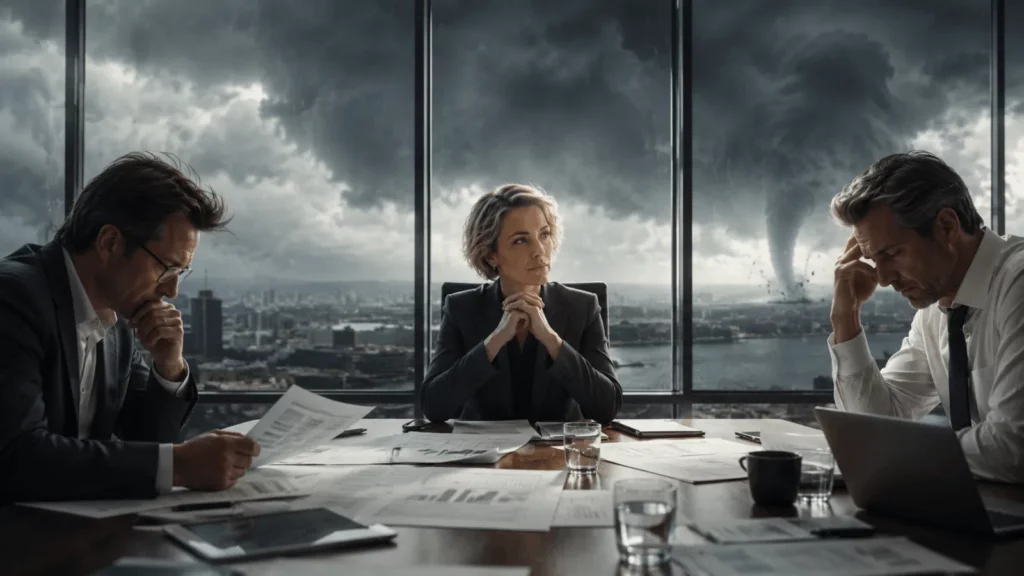

A Recognisable Fracture
A trust gap rarely announces itself with drama.
It usually appears in quieter places. A value on the wall that does not survive a budget meeting. A leadership message about people first, followed by decisions that make people feel disposable. A promise of transparency, followed by silence when the organisation is under pressure.
A trust gap is the distance between what an organisation says, what it does and what it decides.
People do not need perfect organisations. They know trade-offs are real. They know commercial pressure exists. What weakens trust is not every difficult decision. It is the visible contradiction between language, behaviour and choice.
Once that contradiction becomes recognisable, stakeholders begin to listen differently. Employees hear reassurance as management theatre. Customers read purpose as positioning. Partners notice what is avoided. Leaders may still believe they are communicating clearly, but the audience has started measuring them against evidence.
That is what a trust gap looks like.
Why This Moment Matters
Trust has become harder to hold because people have become more skilled at detecting misalignment.
They see the public promise and the private pattern. They compare brand language with employee experience. They watch how quickly principles bend when growth, cost or reputation is at stake. This is why the 2026 Edelman Trust Barometer frames employers as important trust brokers in a climate of insularity, low optimism and resistance to change.
For organisations, this makes trust less of a communications asset and more of an alignment test.
A statement can create expectation. A decision either strengthens it or exposes it. A behaviour either confirms it or quietly cancels it.
The strategic mistake is to treat a trust gap as a messaging problem. It may show up in communication, but it is usually created somewhere else. In incentives. In leadership tolerance. In decision rights. In what gets rewarded, protected or ignored.
Communication cannot permanently repair what the operating system keeps contradicting.
The Evidence on the Ground
The commercial case for trust is no longer soft. PwC’s Trust in US Business Survey found that consumers buy more from companies they trust, employees connect trust with whether they recommend an employer, and executives see trust as tied to customer engagement, productivity and access to capital.
Gallup’s State of the Global Workplace 2026 reported that only 20% of employees worldwide were engaged at work in 2025, which matters because disengagement is often where internal trust gaps become visible before they become reputational problems.
The OECD’s work on institutional trust is also useful for business. Its 2024 Survey on Drivers of Trust in Public Institutions identifies reliability, responsiveness, openness, fairness and integrity as core drivers of trust. The context is public institutions, but the lesson travels well. Trust depends on repeated experience, not declared intent.
The pattern is clear. People trust organisations when the evidence holds together.
What Leaders Actually Face
Most trust gaps are not created by bad intent. They are created by accumulated exceptions.
A leader says wellbeing matters, then praises the team that burns out quietly. A company says inclusion matters, then promotes the same narrow profile of leadership. A brand says it listens, then only hears feedback once it becomes public risk. An organisation says it values integrity, then treats ethical challenge as a lack of commercial realism.
None of these moments may feel decisive in isolation. Together, they form a pattern.
Leaders often face genuine tension. They must protect margin, move quickly, satisfy investors, retain talent, respond to customers and make decisions with incomplete information. The Balanced Movement view does not deny that pressure. It simply refuses the fiction that pressure has no moral or reputational consequence.
A trust gap grows when leaders ask people to believe the language while experiencing the opposite.
That is why trust cannot be delegated to communications teams. It has to be held in the places where choices are made.
The Path Through Integrity
Integrity is not the absence of compromise. It is the discipline of making compromise visible, explainable and accountable.
A mature organisation does not pretend every decision is comfortable. It explains what was weighed. It names the trade-off. It shows what will be protected. It accepts the consequence of the choice.
This is where trust begins to recover. Not through louder values, but through cleaner alignment.
The Balanced Movement lens is simple. Look at the relationship between behaviour, language and decisions. When all three point in the same direction, trust has somewhere to land. When they split, people stop trusting the story and start trusting the pattern.
The work is not to sound more trustworthy. The work is to become harder to disbelieve.
A Clearer Way to Act
Leaders can begin by asking sharper questions.
What do we repeatedly say that our decisions do not support?
Where do employees experience the organisation differently from the way stakeholders hear it described?
Which behaviours are tolerated because they deliver results?
Which decisions would be difficult to explain plainly to the people affected by them?
Where are we using values as language rather than as criteria?
These questions are not reputational housekeeping. They are strategic discipline.
A trust gap narrows when leaders stop defending the gap and start studying it. The aim is not perfection. The aim is coherence. People can respect an organisation that makes difficult decisions with honesty. They struggle to trust one that speaks humanely while acting transactionally.
The practical move is to audit the gap before the market, the workforce or the media does it for you.
The Final, Sharp Thought
A trust gap is not what people think about an organisation.
It is what they can prove.
It is the meeting after the message. The promotion after the pledge. The silence after the promise. The decision after the value statement.
Trust is built when those moments align. It is damaged when they ask people to ignore what they have seen.
Sources and research notes:
Edelman Trust Barometer 2026: https://www.edelman.com/trust/2026/trust-barometer
PwC Trust in US Business Survey: https://www.pwc.com/us/en/library/trust-in-business-survey.html
Gallup State of the Global Workplace 2026: https://www.gallup.com/workplace/697904/state-of-the-global-workplace-global-data.aspx
OECD Survey on Drivers of Trust in Public Institutions 2024: https://www.oecd.org/en/publications/oecd-survey-on-drivers-of-trust-in-public-institutions-2024-results_9a20554b-en/full-report/overview-new-trends-persistent-patterns-and-necessary-changes_f3abe0c7.html